
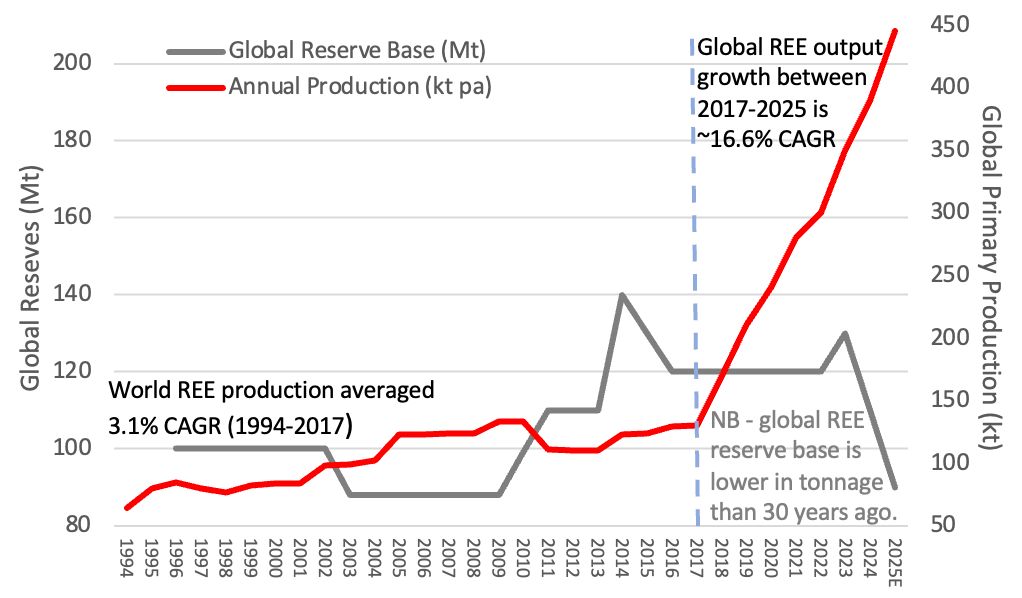
Historically, growth in REE demand was a boutique 3% pa. Although it never made a significant portion of any individual product by weight, value, or volume, REEs were often critical for a piece of equipment to function effectively. A modern ICE vehicle, for example, typically requires more than 200 permanent magnets, including actuators that operate cruise control, fuel injectors, fans, power steering, suspension; electric motors that move seats, operate speakers, alternators, regenerative braking; or sensors for the ABS, airbags, seatbelts, etc.
From 2017 onwards, however, there was a marked technological jump in demand (~17% CAGR), driven by mobile computing, EVs and increasingly, wind turbines. We estimate that REEs support more than half the world’s advanced technologies, because they have a variety of unique magnetic, physical, chemical, and/or luminescent properties that ultimately reduce energy utilisation; which in turn, permit significant efficiency gains, allow miniaturisation, increase speed and durability, with greater thermal stability. In many of the applications, there are no realistic substitutes without the product suffering from substantial operational degradation and/or inefficiencies.
Remarkably then, despite the 590% increase in annual global REE demand over the past 32 years, the underlying global resource base has, in fact, declined by 10%! (Using USGS resource numbers, which are not JORC compliant).