
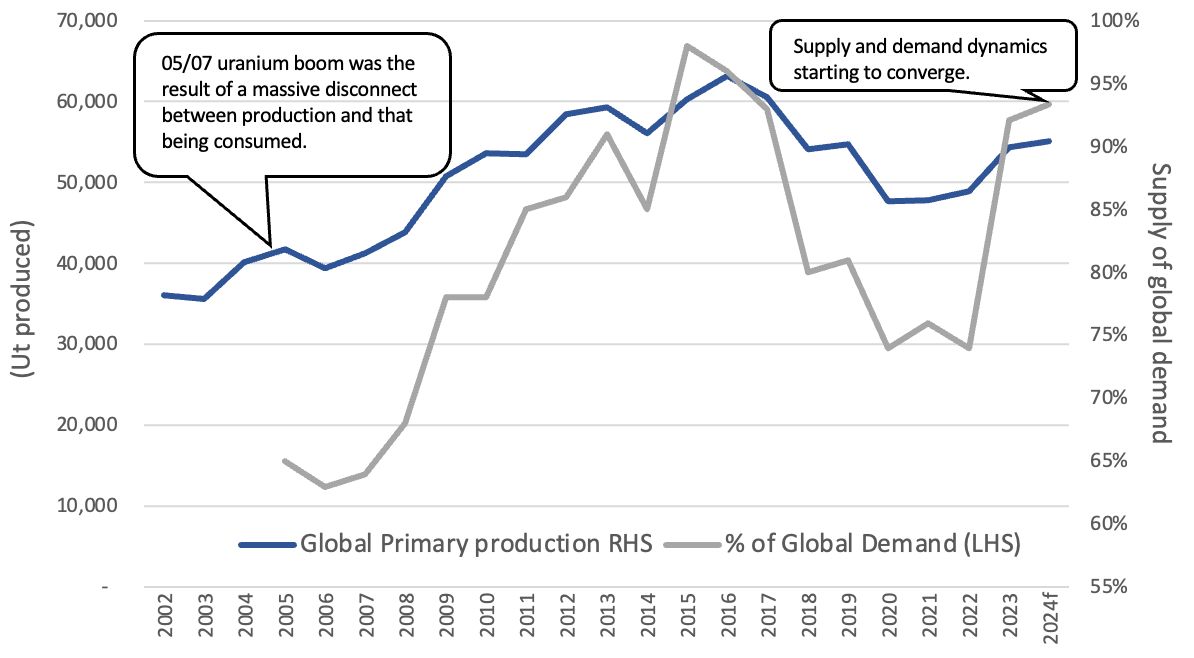
Global uranium production (left) versus primary supply (right). In 2022 primary supply met ~74% of end use demand, the rest coming from existing stockpiles. Using a variety of sources, we now estimate that sector dynamics have improved markedly since, with 93% of 2024f consumption was able to be met via primary supply.
Fundamentally, the underlying demand for uranium is closely tied to the construction and operation of nuclear power plants. The most significant development being the large number of existing nuclear power plants that are undergoing lifetime extension programmes, typically, postponing closure from an initial 40 to 60 years. France is planning to upgrade at least 40 reactors, extending their life spans to >50 years, whilst building an additional six, with a further eight under consideration. In the US, virtually all the 94 operating reactors have already had their licences extended to 60 years, 12 reactors have been approved for operation to 80 years, with the NRC reviewing a further five applications.
A highly volatile sector, it often has periods of dramatic shortages, for example, in 2005, primary output only sated ~65% of global demand. Production can easily be influenced by geopolitical events, particularly due to the fact that supply is concentrated in so few countries; including Kazakhstan (42%), Canada (20%), Namibia (13%), Australia (8%) and Uzbekistan (6%) – collectively making up 89-90% of global output. Russia’s uranium export ban, in particular, has forced a strategic recalibration among many Western nations as to their global uranium procurement strategies.
Nuclear power may not be a panacea for every situation. But for energy poor countries, like many in Europe, who have environmental aspirations, it is the ideal solution.