
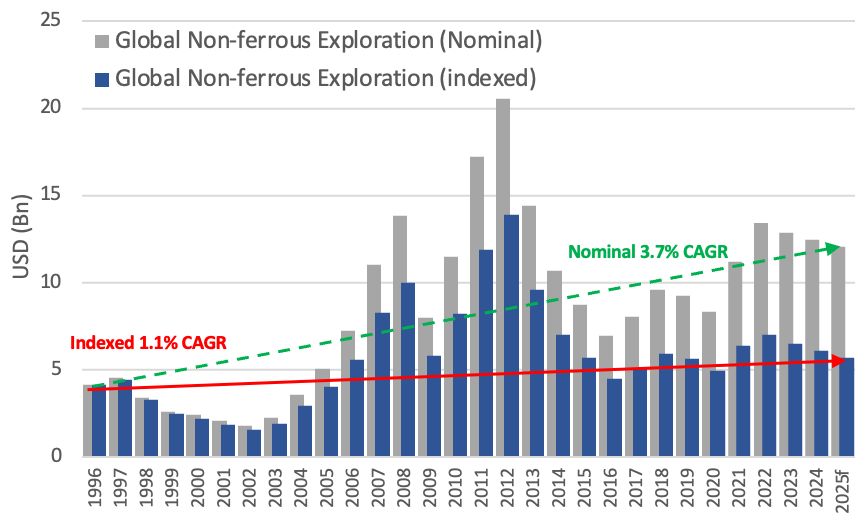
It may surprise that global exploration expenditures in the coming year (2025f) are only 37% higher, in real terms, than what they were 30 years ago! Despite the advent of commodities super cycle associated with the economic rise of China, to become the global manufacturing power house it is today.
In that time, the annual global supply of various commodities have increased dramatically; including zinc output by +67%, lead +54%, nickel +243%, coal +211%, aluminium +251%, and copper +115%, among others.
On that basis, one could conclude that minerals exploration is not that important. Especially when one takes into account that commodity returns (minus gold) have been negative for the past 15 years, at -9% or -0.6% CGAR. This has impacted various deposit types particularly hard, for example, due to lead and zinc prices being in the doldrums for several decades, exploration efforts for VMS deposits that host those minerals (and is the single largest source of primary silver globally) has been virtually non-existent; with future supplies of silver in question. If we were to hazard a guess, on a five year time frame, we expect silver appreciation to strongly outperform that of gold.
Many European investors seem to be oblivious as to the economic importance of commodities, with many labelling the mining and the O&G sectors as forms of environmental vandalism. It ignores the fact that most of the current crop of world class deposits being mined, were discovered four or five decades ago.
By definition, geological prospectivity for many commodities is largely heterogeneous, in that a relatively small number of geological provinces are particularly well endowed in certain deposit types; with the majority having very little important economic mineralisation. Ceteris paribus, means that the easier-to-find deposits (i.e. the ones we are mining currently) will be located first, with the more difficult (future) deposits found later. In this respect, China, has had a three-decade head-start in most metals.
Some uncomfortable truths, include:
(1) Typically takes a decade or more of dedicated exploration to discover an economic deposit in a new region;
(2) It is not uncommon to take an additional several decades (or more) for a major Mining House to develop a mining operation (from the point of discovery), to it becoming a commercial proposition; and
(3) Although SOEs have a particularly poor record in making geological discoveries, they offset this shortcoming with their ability to recognise opportunities and act assertively in acquisitions. The great irony being that the Chinese, historically, have been highly reliant on Western exploration expertise to sustain their current commodity inventories (although this will inevitably change).