
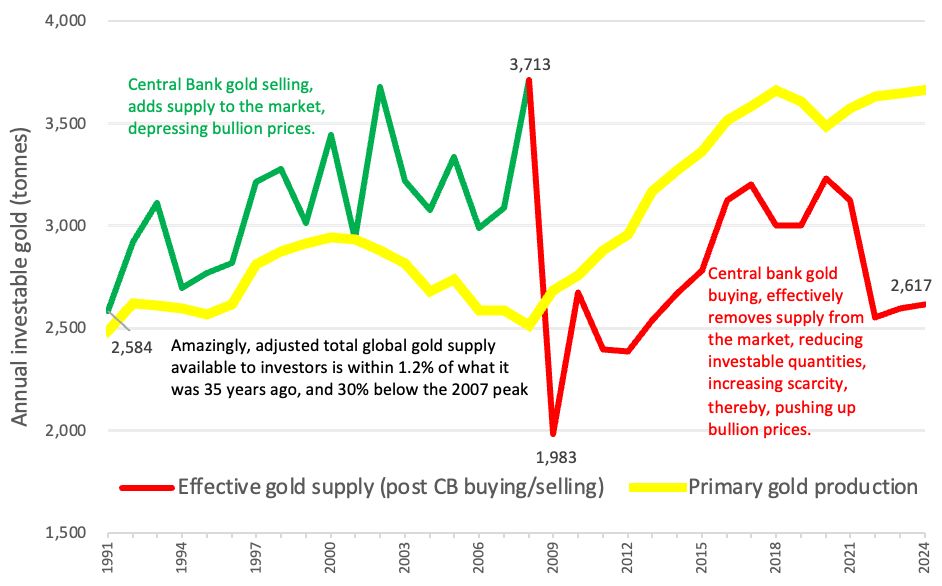
Investors underestimate the role of Central Banks (CBs) in global gold supply. 2024 was the third year in a row that central banks purchased >1,000 tonnes in bullion – effectively removing it from the supply chain. The recent ~60% price rise was not the result of investor speculation, because fund flows into gold ETFs have declined, four years straight.
For several decades before 2008, for a variety of stated reasons, CBs were net sellers. Reasons included a number of European countries reducing their public debt to qualify for entry into the European Monetary Union; or in Australia’s case, exchanging gold reserves for higher yielding major currencies.
Following the GFC in 2009, CBs suddenly became large net buyers, the irony, although they all had great public excuses why they wanted to sell, none were willing to disclose since then why they are buying! We can only speculate as to the exact reasons, but we highlight that as a medium of exchange, gold (i) has inherent value which is recognised universally; (ii) it is the only monetary medium that is not someone else’s liability; and (iii) it cannot be replicated or counterfeited.
The key point made by our diagram below (WGC and USGS data), is that if you add 1991 CB gold sales to primary gold production, and compare it to 2024, annual investable gold supplies have only increased by 1.2% over that 35-year period. Despite the global economy growing >270% and the amount of USD in circulation increasing by 729%. It shouldn’t come as a surprise then that the bullion price has increased by >690% in the interim.
This emphasises the key point that it is increasingly difficult to discover new gold deposits to replace those under current extraction (i.e. discovery depletion), with most of the remaining prospective regions still under the influence of significant geopolitical considerations. What remains, therefore, is typically of poorer quality than those currently operating.