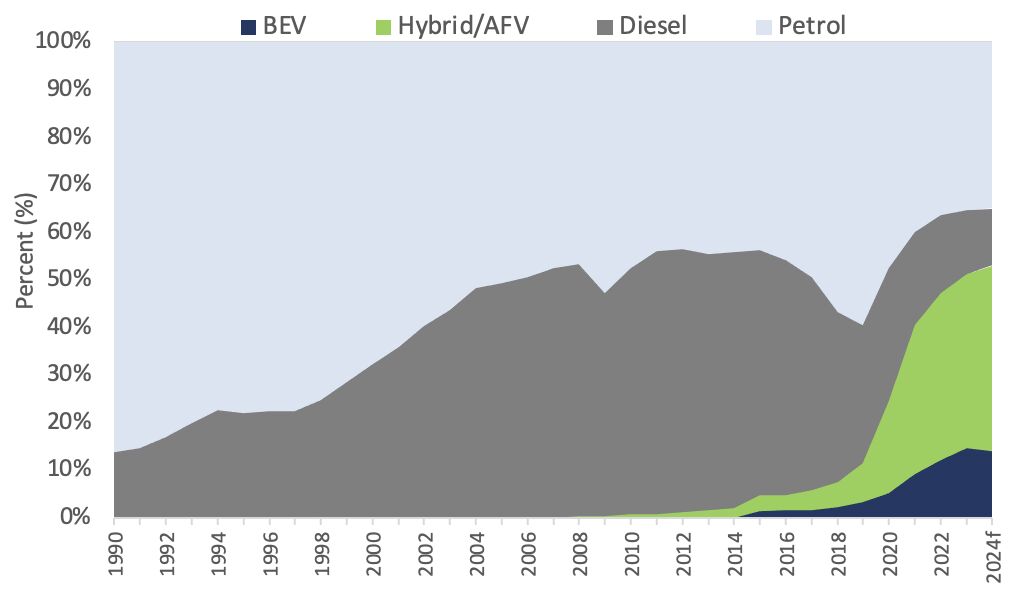
EU car registrations by fuel-type. According to our estimates, Hybrids and alternate fuel vehicles should account for ~39% of all EU vehicle sales in 2024, followed by petrol at 35%. Battery electric vehicle (BEVs) sales may have peaked at 13.6% in 2023, forecasting a modest decline this year.
The EU’s public position remains to implement a ban on sales of all internal combustion engine (ICE) vehicles by 2035; as a key plank toward its 2050 objective of being climate neutral. BEVs continue to have operational shortcomings (e.g. range, recharge rates, longevity) that are chemistry related, and are unlikely to be mitigated significantly by incremental technological development. We now consider the 2035 date to be an aspirational target, unlikely to be realised using current technologies.
Despite generous incentive schemes in some jurisdictions, sales data suggests that it is hybrid/PHEV vehicles that will dominate the EV transition. Hybrids offer economic benefits associated with increased efficiencies, with continued practicality; which speaks to our investment narrative, that if a technology offers more efficient production of superior goods and/or services, then general adoption is rapid. Hybrids clearly meet that brief.
Lastly, the rise of Chinese hegemony in minerals processing has meant that the potential long-term supplies of various materials and componentry may not be as secure as it has historically been under WTO rules. It is increasingly important for Europe to have structural diversity in supply networks, particularly in critical componentry and materials . Given Chinese EV dominance, both in cost, and increasingly in technological innovation, it may be wise for the EU to retain expertise and manufacturing capabilities in ICE technologies as a strategic imperative.